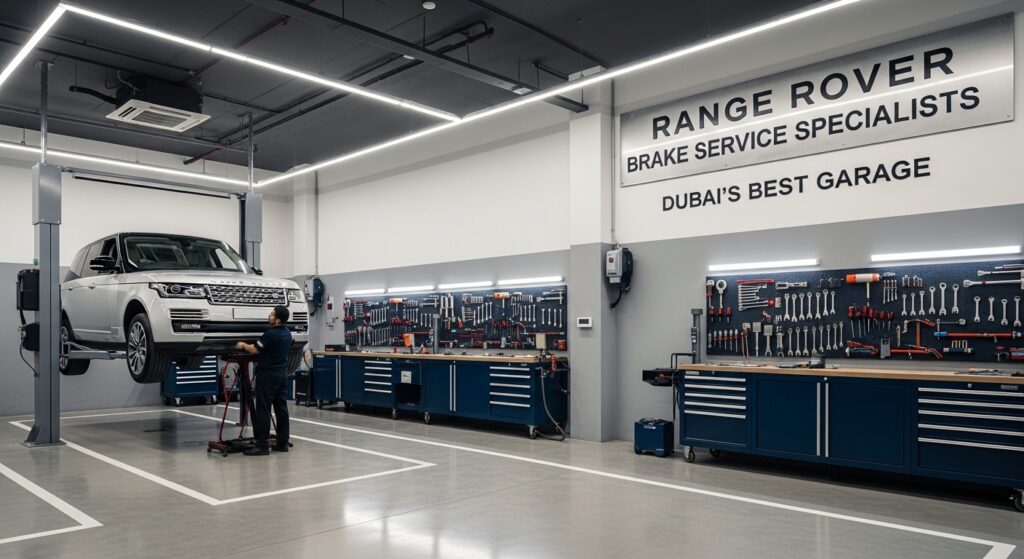
Best Garage For Range Rover Brake Service Dubai: The heat was pushing 48°C last Tuesday when a Range Rover Sport pulled into our Al Quoz workshop. The owner looked stressed. Every time he touched the pedal, a high-pitched metallic scream echoed through the cabin. He’d just come off Sheikh Zayed Road, and the brakes were literally smoking. In the Dubai summer, your braking system isn’t just a mechanical component; it’s a thermal management challenge. That screech wasn’t just a nuisance. It was the sound of a high-performance Brembo system begging for mercy after being cooked in stop-and-go traffic.
Finding the best garage for Range Rover brake service Dubai isn’t about finding the cheapest quote. It’s about finding a team that understands why these 2.5-ton British beasts behave differently in the desert than they do in the rainy hills of Solihull. If you’ve felt a vibration in the steering wheel or seen a “Brake Pad Wear” light, you’re already on borrowed time.
Best Garage For Range Rover Brake Service Dubai
The Science of Dubai: Why Your Brakes Give Up
The UAE environment is a triple threat to luxury braking systems. First, you have the extreme heat. While brakes are designed to get hot, the ambient 50°C temperature means they never truly cool down between stops. This leads to “brake fade,” where the fluid loses its hydraulic effectiveness.
Second, the humidity and coastal salinity in areas like Dubai Marina or Jumeirah accelerate corrosion on the rotors. If you leave your car parked for a week while traveling, you might notice a layer of “flash rust” that causes a grinding noise on your first drive.
Finally, the fine desert sand acts like an abrasive sandpaper. It gets trapped between the pad and the rotor, scoring the metal and shortening the life of your sensors. This is why a Range Rover that might get 50,000km out of its brakes in Europe will struggle to hit 30,000km here.
Need an urgent brake health check? Message us on WhatsApp for a same-day diagnostic at our Al Quoz facility.
10 Warning Signs Your Range Rover Brakes are Failing
In our workshop experience, most owners wait too long. They ignore the subtle hints until the repair bill doubles. Here is what you need to watch for:
The Squeal of Death: This is usually the wear indicator hitting the rotor. It’s a literal alarm bell.
Steering Wheel Shudder: If the wheel shakes when you slow down from 100km/h, your rotors are likely warped due to heat stress.
The “Spongy” Pedal: If the pedal feels soft or sinks to the floor, you might have air in the lines or moisture-contaminated fluid.
Metallic Grinding: This means the friction material is gone. You are now grinding metal on metal, which destroys the rotors instantly.
Dashboard Warning Light: Range Rovers use electronic wear sensors. Once that light is on, you have roughly 1,000km of “safe” driving left.
Pulling to One Side: This often indicates a seized caliper or a collapsed brake hose—a common issue in older Vogues.
Burning Smell: After a heavy braking session, a sharp, acrid smell indicates the pads are overheating.
Longer Stopping Distances: It’s subtle, but if you feel you’re pressing harder to stop at the same red light, the system is failing.
Clicking Noises: Sometimes a loose caliper or a broken anti-rattle clip causes a rhythmic clicking.
Brake Fluid Leaks: Look for oily puddles near the inside of your wheels. This is a “do not drive” situation.
If you are experiencing any of these, don’t wait. A simple pad change is much cheaper than a full Transmission service or engine overhaul if an accident occurs.
Brand Battle: European Precision vs. The Dubai Reality
Range Rovers are engineered to a higher standard than your average sedan. The weight and torque of a Supercharged V8 require massive stopping power. However, comparing them to Japanese or American rivals reveals a distinct maintenance philosophy.
Japanese SUVs like the Land Cruiser use harder, more durable pad compounds that last longer but offer less “bite.” Range Rover uses softer, high-friction compounds. These provide that “executive” stopping feel where the car halts with zero effort, but they wear out much faster.
American SUVs often use massive, heavy rotors that dissipate heat well but add significant unsprung weight. Range Rover balances this with aluminum components and complex ducting. The catch? If those ducts get clogged with Dubai sand, the cooling system fails, and the rotors warp.
Delaying service on a Range Rover isn’t just about safety; it’s about protecting the resale value. A car with “Brake Pulse” or scarred rotors will fail a pre-purchase inspection (PPI) instantly.
Call our head mechanic directly at +971569371471 to discuss your Range Rover’s braking performance.
Professional Diagnostics: More Than Just a Visual Check
A lot of small shops in Al Quoz will just look at the pads and say, “You’re fine.” That’s not how we do things at Expert Car Repair Dubai. A luxury SUV requires digital and physical precision.
We use Autel and Snap-on diagnostic tablets to interface with the Land Rover Bosch ABS modules. This allows us to check for “ghost codes” in the electronic parking brake (EPB) system. Many Range Rover Sport models suffer from EPB failure where the actuator seizes—a repair that can cost thousands if the module burns out.
We also utilize Hunter specialized alignment and vibration tools. If your brakes are perfect but you still feel a shimmy, it might be the suspension bushings or a wheel imbalance—issues that often masquerade as brake problems. Checking the Battery health is also vital, as low voltage can trigger false “Brake System Fault” messages on the digital dash.
2026 RTA Legal Standards & Pricing Guide
In 2026, the RTA (Roads and Transport Authority) has tightened the “Tajdeed” (registration renewal) protocols. Brakes are now tested on a rolling road that measures “Brake Imbalance.” If there is more than a 25% difference in stopping power between the left and right wheels, your car will fail the inspection.
Here is a breakdown of what you can expect to pay for a professional Range Rover brake service in Dubai this year:
| Service Component | Genuine JLR Parts (AED) | High-Quality Aftermarket (AED) |
| Front Brake Pads | 950 – 1,500 | 550 – 850 |
| Rear Brake Pads | 750 – 1,200 | 450 – 700 |
| Brake Rotors (Pair) | 2,200 – 3,500 | 1,200 – 1,800 |
| Wear Sensors (Per Axle) | 150 – 250 | 80 – 120 |
| Brake Fluid Flush (DOT 4/5.1) | 350 – 500 | 200 – 300 |
| Total Estimated Service | 4,400 – 6,950 | 2,480 – 3,770 |
Note: Prices vary based on specific models (Evoque vs. Full-Size Vogue) and current MOIAT import regulations on spare parts.
Workshop Insider Secret: How to Double Your Brake Life
Our Head Mechanic, who has been working on Land Rovers since the P38 era, always tells clients the same thing: “It’s not the heat; it’s the dust.”
Here is the secret: Most people in Dubai never wash the inside of their wheels. Brake dust is corrosive. When combined with humidity, it forms a paste that eats into the rotor surface. Every time you go for a car wash, ask the attendant to spray the high-pressure hose directly through the wheel spokes onto the calipers and rotors. This clears out the sand and dust that causes “grooving” and premature wear.
Also, avoid “riding the brakes” on the E11 or Hessa Street. Range Rovers have incredible engine braking. If you use the paddle shifters to downshift when slowing down, you take the thermal load off the pads. This simple habit can add an extra 10,000km to your service interval.
If your AC is running at full blast (which it always is), remember that your engine is already under load. Adding heavy braking generates massive engine bay heat. Ensure your cooling fans are working perfectly to help pull heat away from the front braking assembly.
Frequently Asked Questions (FAQ)
1. How long does a Range Rover brake service take in Dubai?
Typically, a standard pad and sensor replacement takes 2 to 3 hours. If the rotors need resurfacing (machining) or replacement, expect to leave the car for 5 to 6 hours.
2. Can I use aftermarket pads on my Range Rover?
Yes, but be careful. We recommend brands like Brembo, Akebono, or EBC. Cheap, unbranded pads will squeal incessantly and may not handle the weight of the vehicle during an emergency stop.
3. Why does my Range Rover say “Brake Pad Wear” when the pads look thick?
The electronic sensor might be damaged, or the inner pad (which you can’t see easily) might be wearing faster than the outer one due to a sticky caliper piston.
4. Is it mandatory to change rotors every time I change pads?
Not always. At Expert Car Repair Dubai, we measure the rotor thickness with a micrometer. If they are above the minimum “discard thickness” and aren’t warped, we can simply install new pads.
5. Does the RTA check brake fluid during the annual test?
They check the level and look for leaks. However, they don’t test for moisture content. We recommend a fluid flush every 2 years because brake fluid is hygroscopic (it absorbs water), which lowers the boiling point—dangerous in 50°C weather.
6. My brakes are squeaking but the car is brand new. Why?
This is common with high-performance ceramic or semi-metallic pads. A thin layer of dust or “glazing” from light braking can cause this. A few firm stops usually clears it up.
7. How much does the RTA charge for a re-test if I fail on brakes?
In 2026, the first re-test for a light vehicle is usually around AED 35 to AED 50, provided you return within the 30-day window with the repairs completed.
8. Can a faulty brake sensor cause other dashboard lights?
Yes. In the integrated systems of a modern Range Rover, a brake fault can sometimes disable the Cruise Control, Emergency Braking, or even the Terrain Response system.
9. What is the difference between “resurfacing” and “replacing” rotors?
Resurfacing (or skimming) uses a lathe to remove a thin layer of metal to make the surface flat again. Replacing is necessary if the rotor is too thin or has deep cracks.
10. Do you provide a warranty on brake repairs?
Absolutely. We provide a 6-month or 10,000km warranty on all labor and genuine parts installed at our Al Quoz workshop.
Ready to get your Range Rover back to peak safety? Contact Expert Car Repair Dubai at +971569371471 for a transparent, professional experience.
The reality is that Dubai’s roads are unforgiving. Whether you are navigating the school run in Arabian Ranches or cruising down to Abu Dhabi, your brakes are the only thing standing between a controlled stop and a very expensive disaster. We see it every day: a client tries to save AED 200 at a “backstreet” garage, only to end up with vibrating pedals and ruined wheels two weeks later.
At Expert Car Repair Dubai, we treat every Range Rover like it’s our own. We don’t just swap parts; we inspect the Brake lines and calipers to ensure the entire system is pressurized and performing at factory specs.
Don’t let a “minor” squeak turn into a major headache. Our team is standing by to provide the precision your vehicle deserves.
Final Point of Contact:
Location: Al Quoz Industrial Area, Dubai
Phone: +971569371471
WhatsApp: +971569371471
Would you like me to book a free brake inspection for your Range Rover this week?