
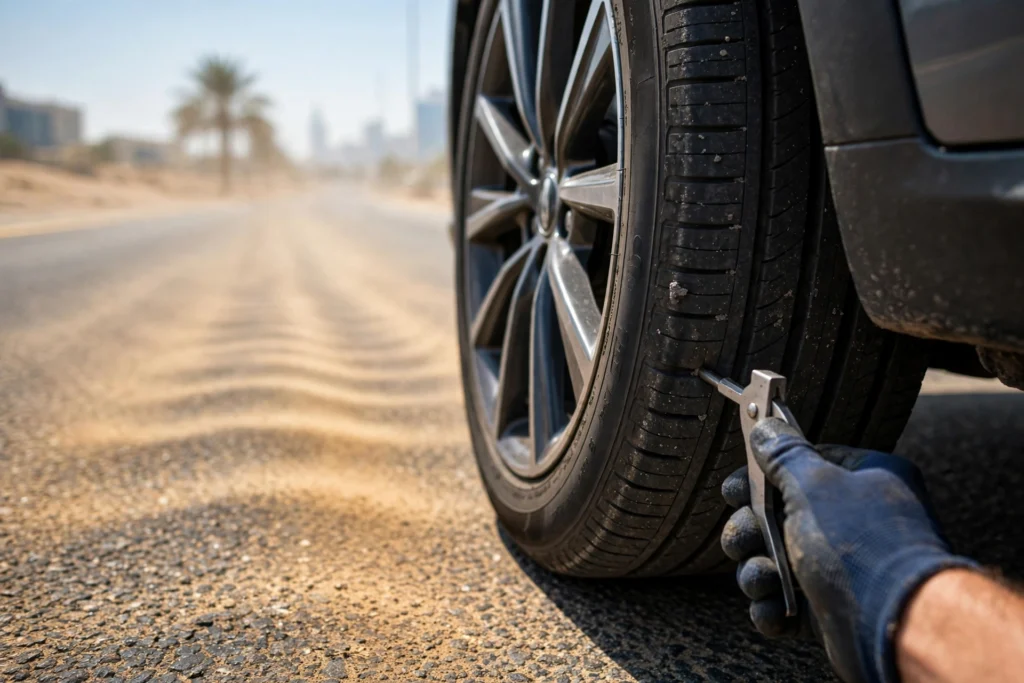
These tyre care tips for UAE drivers start with a simple fact. Heat is hard on tyres. In summer, road surfaces in Dubai can get far hotter than the air around them, and a tyre low on pressure, worn, or old will suffer faster. The good news is that most tyre damage can be slowed down with a few regular checks. This guide explains why hot roads wear tyres out, and gives you six practical tips you can follow without any special tools.
Why Hot Roads Wear Tyres Out Faster
A tyre is made of rubber, steel, and fabric layers working together. Heat softens rubber and speeds up ageing. When a tyre rolls on a hot road, the rubber flexes with every turn of the wheel. If the pressure is too low, the tyre flexes even more, builds up more heat inside, and wears unevenly, which can weaken its structure over time.
Strong sunlight also ages the sidewall rubber, especially on a car parked in the open all day, and fine sand can work into small cracks and tread grooves. A small monthly routine makes a real difference. The Wikipedia guide to tyres explains how a tyre is built and why pressure, tread, and heat matter so much.
6 Tyre Care Tips for UAE Drivers
Tip 1: Check Tyre Pressure Every Month, When the Tyres Are Cold
Tyre pressure is the single most important check, and it is also the easiest to get wrong. Pressure rises as a tyre warms up, so a reading taken after a long drive will look higher than the real cold pressure. Check your tyres in the morning, before you drive, or after the car has been parked for at least three hours.
Use the pressure listed on the sticker inside the driver door or in the owner’s manual, not the number printed on the sidewall. The sidewall number is a maximum limit, not the pressure your car should run on. Check all four tyres and the spare. A tyre that is even a little low will run hotter and wear at the edges, while a tyre that is too high will wear in the middle. In summer, make this a monthly habit, and always check before a long highway trip.
Tip 2: Look at the Tread and the Sidewall, Not Just the Pressure
Tread is what grips the road, especially when the road is wet after rain or a wash. Look across the full width of each tyre. If the centre is worn but the edges look fine, the pressure may have been too high. If both edges are worn but the centre looks fine, the pressure may have been too low. If one side is worn more than the other, the wheel alignment may need attention.
Most tyres have small raised wear bars inside the tread grooves. When the tread wears down to the level of those bars, the tyre has reached the end of its safe working life and should be replaced. Also look at the sidewall for cracks, cuts, bulges, or a nail or screw stuck in the tread. A bulge means the inner structure is damaged. If you spot any of these problems, book a check at a tyre service in Dubai so a technician can inspect the tyre properly.
Tip 3: Rotate, Balance, and Align on Schedule
Front tyres and rear tyres do not wear at the same rate. Front tyres carry the engine, do most of the steering, and take most of the braking force, so they usually wear faster. Rotating the tyres means moving them to a different position on the car, which spreads the wear more evenly. Your owner’s manual will suggest how often to do this, often at a regular service visit.
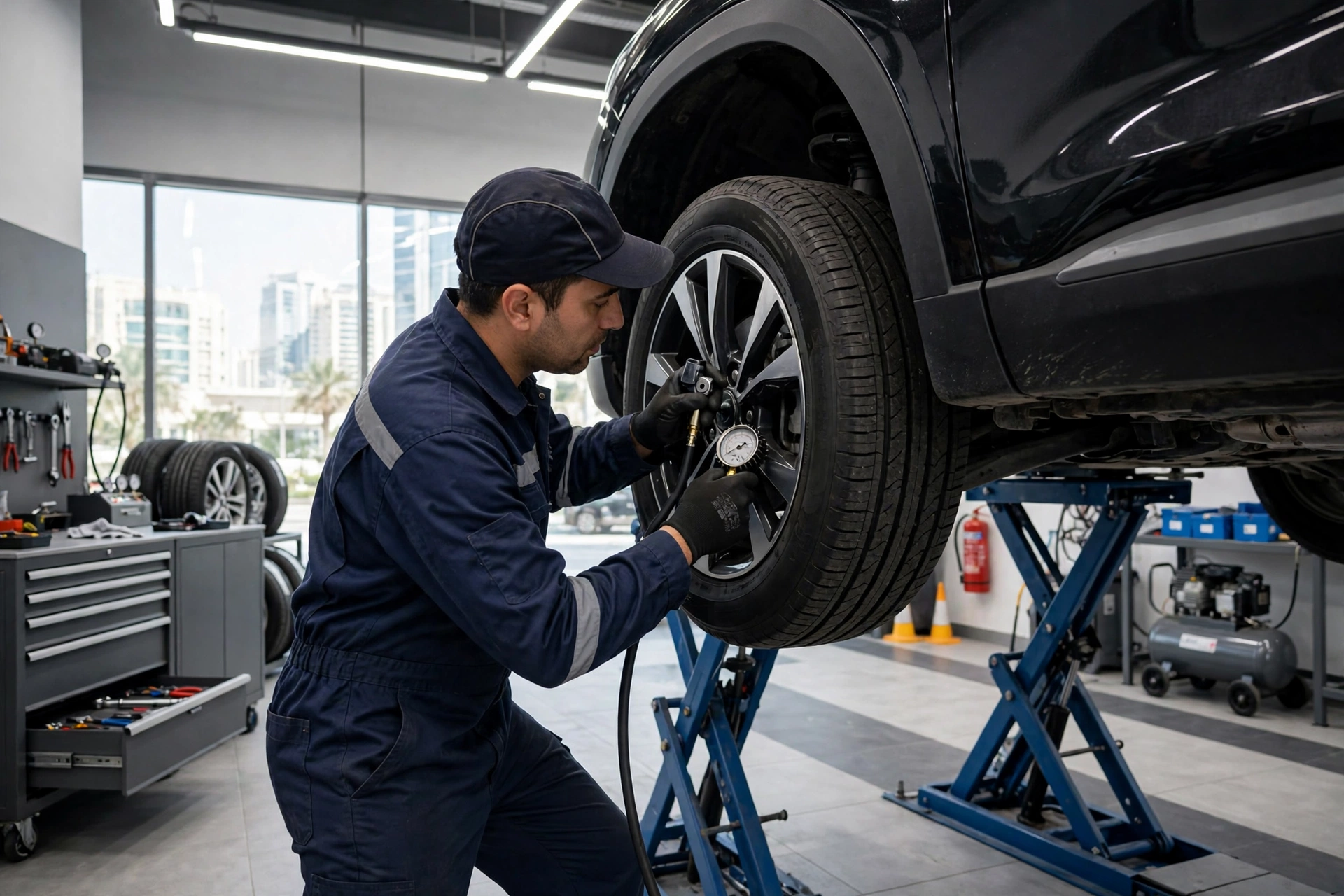
Balancing and alignment matter just as much. An unbalanced wheel can cause vibration at higher speeds, and poor alignment can scrub rubber off one edge of a tyre quickly. If your car pulls to one side, the steering wheel sits off centre on a straight road, or you feel vibration through the steering wheel, ask for an alignment and balance check. These checks are a normal part of a car maintenance service in Dubai.
Tip 4: Park in the Shade When You Can
Parking in direct sun all day heats the tyres and, over months and years, ultraviolet light helps age the sidewall rubber. If you have a shaded spot, a covered parking bay, or a garage, use it for your daily parking.
Tip 5: Drive Smoothly and Watch for Potholes and Kerbs
Hard braking, fast cornering, and sudden acceleration all scrub rubber off the tread. Smooth, steady driving will help your tyres last noticeably longer. On Dubai roads, potholes, sharp kerbs, and speed bumps taken at speed are other enemies. Hitting a kerb or a deep pothole can cut the sidewall, damage the rim, or knock the alignment out in a single moment.
Keep a sensible distance from the car ahead so you can see road damage early, and slow down for speed bumps instead of rushing over them. Also avoid overloading the car, because a heavily loaded car puts extra strain on the tyres, builds up more heat, and wears the tread faster.
Tip 6: Check the Age of Your Tyres, Including the Spare
Tyres age even if they are not used much. The age of a tyre is printed on the sidewall as a four digit code, usually after the letters DOT. The first two digits are the week of manufacture and the last two are the year. For example, a code ending in 2323 means the tyre was made in the 23rd week of 2023.
As a general guide, tyres older than five years should be inspected carefully, even if the tread still looks deep, and older tyres with cracks or hardening should be replaced. This matters more in the UAE, where heat speeds up ageing. The spare tyre is easy to forget because it sits out of sight, so check its pressure and age at the same time as your other tyres.
A Simple Monthly Tyre Check You Can Do Yourself
Once a month, walk around the car and work through this short list:
- Pressure: Check all four tyres and the spare when cold, using the door sticker pressure.
- Tread: Look for wear bars, uneven wear, and any object stuck in the tread.
- Sidewall: Look for cracks, cuts, and bulges on the inner and outer sidewalls you can see.
- Valve caps: Make sure every valve cap is fitted, so dust and sand cannot get into the valve.
- Feel on the road: Note any new vibration, pulling, or noise, and mention it at your next service.
This check takes about ten minutes, and it pairs well with the monthly checks in our guide to a car service schedule in Dubai. Catching a slow leak or a worn edge early is far simpler than dealing with a tyre failure on a busy highway.
When to Visit the Workshop for Your Tyres
Some tyre problems should not wait for the next routine service. Visit a workshop soon if you notice any of these signs:
- A bulge, deep cut, or crack on the sidewall
- A tyre that keeps losing pressure, even after it is topped up
- Vibration at speed that was not there before
- The car pulling to one side on a straight, flat road
- Uneven wear that is getting worse from one month to the next
- A nail, screw, or other object stuck in the tread
A technician can tell you whether a tyre can be repaired safely or needs to be replaced. Never keep driving on a tyre with a visible bulge or a deep sidewall cut. Tyres are the only part of the car that touches the road, and a failure at speed is a serious safety risk.
Before a Long Summer Trip
Highway driving in summer puts the most stress on tyres, because the car runs at a steady high speed for a long time and the tyres stay hot. Before a long trip, do the full monthly check, and add two extra steps. First, check the spare tyre, the jack, and the tools for a roadside wheel change. Second, if the car will be fully loaded, set the pressure to the loaded figure in the owner’s manual if one is given.
On the trip itself, take a break every couple of hours. If you hit a pothole hard during the trip, stop somewhere safe when you can and look at the tyre and rim for visible damage before you carry on.
Final Thought
Tyre care in the UAE is not complicated. It is mostly about pressure, tread, age, and attention. A driver who checks pressure monthly, watches the tread and sidewalls, rotates and aligns on schedule, and acts quickly on warning signs will get far more safe life from a set of tyres than a driver who ignores them until something goes wrong.
If you are unsure about a tyre, or you want a trained eye on the full set before summer or a long trip, call or WhatsApp Expert Car Repair Dubai on +971 56 937 1471. Our workshop is at the Binghatti Stars Building, Dubai Silicon Oasis, opposite Lulu Hypermarket, Dubai, UAE. We will inspect your tyres, check the pressure, tread, and alignment, and tell you clearly what needs attention.
Frequently Asked Questions
How often should I check tyre pressure in the UAE summer?
Check tyre pressure at least once a month in summer, and always before a long highway trip. Check when the tyres are cold, using the pressure on the driver door sticker or in the owner’s manual. A monthly check catches slow leaks before they turn into a hot, underinflated tyre.
Can hot roads really damage a tyre that looks fine?
Yes. Heat speeds up rubber ageing even when the tread still looks deep. A tyre can look fine on the outside while the rubber has hardened or small cracks have formed in the sidewall. That is why age checks and sidewall checks matter as much as tread depth.
How do I know if a tyre is too old?
Find the four digit DOT code on the sidewall. The first two digits are the week and the last two are the year of manufacture. As a general guide, tyres older than five years should be inspected carefully, and any tyre with cracks or hardening should be replaced, even if the tread looks good.
Is it safe to drive with a small bulge or cut in a tyre?
No. A bulge means the inner structure of the tyre is damaged, and a deep cut can weaken the sidewall. Do not keep driving on such a tyre in the hope that it will last longer. Have it inspected as soon as you can, and replace it if the technician advises it.
Do I need to check the spare tyre too?
Yes. Check the spare tyre pressure and age at the same time as your other tyres. A spare that is flat or cracked will not help you when you need it, and many drivers only discover the problem at the roadside. A monthly check takes less than a minute.