
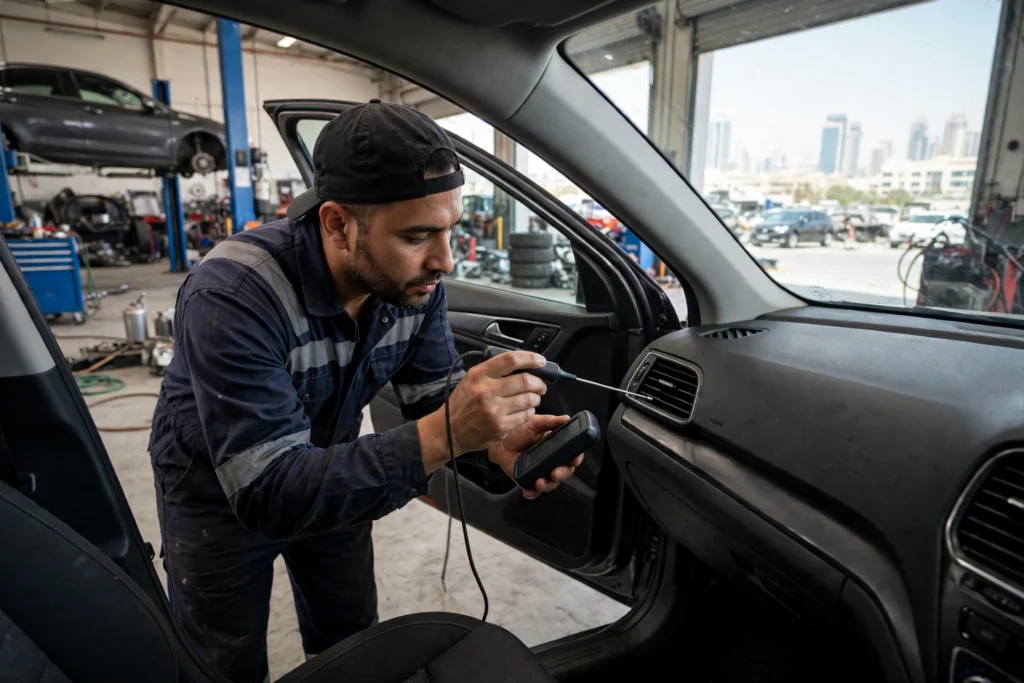
It is the most common AC complaint in Dubai. The air feels cold while you are driving, then the car stops at a traffic light or crawls through Sheikh Zayed Road traffic, and the cabin slowly turns warm. By the time you park, you are sweating in a car that was fine on the highway.
If your car AC is not cooling in traffic but works at speed, the system is usually not dead. It is struggling. This guide explains the real causes, what you can check yourself in two minutes, and which faults need a workshop. If you already know you need help, call or WhatsApp Expert Car Repair Dubai on +971 56 937 1471.
Why Traffic Makes a Weak AC Show Itself
Your AC system removes heat from the cabin and throws it out through the condenser, the radiator-like part at the front of the car. That only works when air flows through the condenser. At highway speed, the wind does the job. In traffic, your car depends on the electric cooling fan and on a healthy system with no weak points.
Dubai adds three problems. The outside air can pass 45 degrees in summer, so the condenser has to fight much hotter air. Dust and sand coat the condenser fins and block airflow. And long idling in the sun heats the whole engine bay. A system that is slightly low on gas or has a tired fan can still cope at speed, then fail the moment the car slows down. You can read how the system works in general on this overview of automobile air conditioning.
9 Causes of Car AC Not Cooling in Traffic
1. Low refrigerant gas
The most common cause. AC gas does not get used up like fuel. If the level is low, there is a small leak somewhere, often at a hose joint, a seal, or the condenser. A system that is a little low cools weakly, and the weakness shows first at idle. Topping up the gas without finding the leak only buys a few weeks or months.
2. A cooling fan that is weak or not working
In traffic, the fan is everything. If the fan motor is worn, the fan relay has failed, or the fan only runs on one speed, the condenser cannot dump its heat while the car is standing. The AC then warms up at lights and cools again when you move. This is one of the first things we check on any AC complaint in Dubai.
3. A condenser blocked with dust and sand
The condenser sits at the very front of the car and collects dust, sand, plastic bags, and insects. In Dubai, a fine layer of sand builds up between the fins and quietly blocks airflow. The system then works on the open road and struggles in slow traffic. Careful cleaning restores airflow, but bent or corroded fins may mean the condenser itself is finished.

4. A compressor that is getting tired
The compressor is the heart of the system. As it wears, it pumps less, and its weakness shows most at low engine speed, which is exactly where your car sits in traffic. Early signs are cooling that fades at idle and returns when you rev the engine slightly, sometimes with a new noise when the AC switches on.
5. A dirty cabin filter
The cabin filter cleans the air coming into the car. Dubai dust clogs it faster than most drivers expect. A blocked filter cannot cause warm air by itself, but it cuts the airflow so much that the cooling feels weak, mostly on lower fan settings. It is cheap to check and often forgotten.
6. The engine running hotter than it should
AC and engine cooling share the same front fans and the same hot engine bay. If your engine temperature creeps up in traffic because of a cooling problem, many cars reduce or cut the AC to protect the engine. If your temperature gauge rises in traffic, treat that as the main problem, not the AC. Our article on common engine overheating issues explains the cooling side in more detail.
7. A blend door or control fault
Inside the dashboard, small doors mix hot and cold air. If a blend door sticks or its motor fails, one side of the car may blow warm while the other side stays cold. This is an electrical and mechanical fault, not a gas problem, and adding gas will not fix it.
8. An expansion valve or drier problem
These smaller parts control how the refrigerant flows. When they block or fail, cooling becomes uneven: cold for a few minutes, then warm, then cold again. Ice forming on the AC lines under the bonnet is a clue that something in the flow is wrong.
9. A slipping drive belt or electrical fault
If the belt that drives the compressor is worn or loose, the compressor may not turn properly at idle. Blown fuses, a faulty pressure switch, or a wiring problem can also switch the compressor off in certain conditions. These need proper testing, which is part of our car electrical repair service.
What You Can Check Yourself in Two Minutes
- Feel both sides. If one side is cold and the other warm, think blend door, not gas.
- Listen at idle. With the AC on and the car parked, the front fans should be running strongly. Silence or a weak fan points to the fan system.
- Watch the temperature gauge. If it climbs in traffic, the cooling system needs attention first.
- Check the airflow strength. Weak air on all settings often means a clogged cabin filter.
- Note when it happens. Warm only at idle, warm all the time, or warm after 20 minutes are three different fault patterns. Tell the workshop which one you have.
What not to do: do not keep adding gas cans yourself. Overfilling can damage the compressor, and a system that needs gas again has a leak that should be found and fixed.
When It Is Time for the Workshop
Bring the car in if the AC is warm most of the time, if the fans do not run, if the temperature gauge rises, or if a previous gas refill only lasted a short while. A proper AC check covers gas pressure on both sides of the system, fan operation, condenser condition, compressor performance, and a leak test where the pressures suggest one. That full check is what our car AC repair in Dubai service is built around. Guessing and changing parts one by one usually costs more than testing properly once.
How to Help Your AC Survive Dubai Summer
- Park in shade or use a sunshade. A cooler cabin is less work for the system.
- Open the windows for the first minute of driving to push the hottest air out, then switch to recirculation.
- Change the cabin filter on schedule, and sooner if you drive in dusty areas.
- Run the AC regularly, even in winter. It keeps the seals and compressor healthy.
- Get weak cooling checked early in the season, before it fails completely in August traffic.
- Keep up with normal servicing. Engine cooling and AC health are connected, as our car maintenance guide explains.
The Short Version
If your car AC cools on the highway and warms up in traffic, the usual suspects are low gas from a small leak, a weak cooling fan, or a condenser blocked with dust. All three are fixable, and all three get worse if you ignore them. Get the system tested properly, fix the cause, and the AC will hold its cold in traffic as well as on the open road.
Call or WhatsApp: +971 56 937 1471 | WhatsApp Us
Frequently Asked Questions
Why does my car AC stop cooling when I stop at a traffic light?
At a standstill there is no wind through the condenser, so the system depends on the electric fan and on correct gas pressure. Low gas, a weak fan, or a dust-blocked condenser can still cope at speed but fail at idle. Those three causes explain most cases we see in Dubai.
Does my car just need an AC gas refill?
Maybe, but gas only gets low when there is a leak. A refill without a leak check often lasts a few weeks or months before the same problem returns. The better order is pressure testing, leak checking, repairing the leak, then refilling to the correct level.
Can a dirty cabin filter make the AC feel weak?
Yes. A clogged cabin filter cuts the airflow into the cabin, so even cold air arrives as a weak flow. It does not make the air warm, but in Dubai dust it clogs quickly and is one of the cheapest checks you can do.
Is it safe to drive with the AC not cooling?
Usually yes, if the engine temperature stays normal. But if the temperature gauge rises in traffic, or the fans are not running, the same fault may be hurting engine cooling too. In that case get the car checked promptly and avoid long idling.
How can I tell if the compressor is failing?
Common signs are cooling that fades at idle and improves when you rev the engine, new noises when the AC switches on, and cooling that has slowly got weaker over a season. A pressure test confirms it. Compressor problems should be diagnosed before any parts are changed.