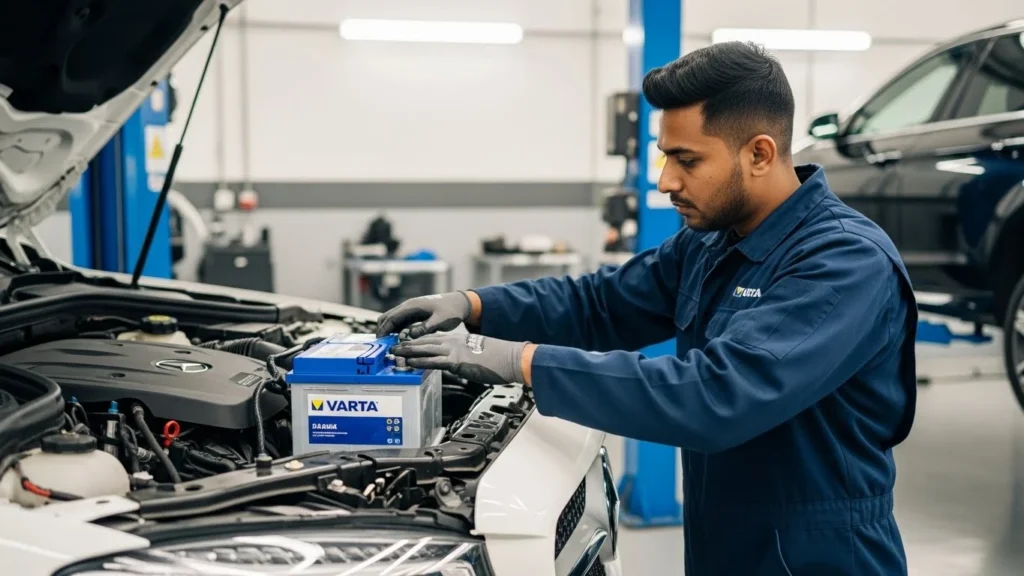

You charge the battery or jump start the car, and everything works fine. Then next morning it is dead again. When your car battery keeps dying overnight, it feels like the battery itself is faulty. Sometimes it is. But in many cars the real cause is something else that is quietly draining the battery while the car sits parked. This guide walks through the 7 most common causes we see in Dubai, the simple checks you can do yourself, and when it is time to let a workshop find the fault.
1. A Battery That Has Simply Reached the End of Its Life
Car batteries in Dubai live hard lives. Constant heat speeds up the chemical wear inside the battery, and most batteries here last only 2 to 3 years. If your battery is older than that and your car battery keeps dying overnight, the battery itself is the first suspect. It can no longer hold a full charge, so even a healthy charging system cannot keep it alive through the night.
Look for a sticker or code on the battery showing the installation date. If you cannot find one, most workshops can test the battery’s remaining health in a few minutes. Our guide on how long car batteries last in Dubai explains the full picture, including the early warning signs most drivers miss.
2. A Parasitic Drain That Empties the Battery Overnight
A parasitic drain is current flowing out of the battery when everything should be off. Small drains are normal. The clock, the alarm, the engine computer’s memory all take a tiny sip of power. For background on how car batteries and their charging systems work together, see the automotive battery overview on Wikipedia. But if something faulty keeps drawing real current, the battery can be flat by morning.
Common sources include a glove box or boot light that stays on, a faulty relay that never releases, an aftermarket alarm or dashcam wired to constant power, or an audio amplifier that never switches off. If your car battery keeps dying overnight but holds a charge when the battery is disconnected from the car, you almost certainly have a parasitic drain. Finding it means measuring the current draw with the car asleep and pulling fuses one by one until the draw drops. That is a workshop job, but the test is quick for anyone with the right equipment.
3. Corroded or Loose Battery Terminals
This one fools a lot of people. The battery might be fine and fully charged, but a corroded or loose terminal stops the charge reaching the starter. The car cranks slowly or not at all, and it looks exactly like a dead battery.

Open the bonnet and look at the terminals. White, green or blue crust around the posts is corrosion. A terminal that you can wiggle by hand is too loose. You can clean light corrosion yourself with a wire brush and warm water, then tighten the clamp so it does not move at all. Wear gloves and eye protection while you work, and never let a metal tool touch both terminals at once.
4. Lights or Accessories Left On
Before assuming the worst, check the obvious. Interior dome lights, boot lights, hazard lights, or a dashcam running overnight can all drain a battery that is already weak. Newer cars warn you when you leave lights on, but an older car or an accessory wired directly to the battery will not.
Do a walk around your car at night with the doors closed and locked. Look for any glow inside the cabin or boot. It takes only a few seconds and has saved many drivers a trip to the workshop.
5. A Failing Alternator That Does Not Fully Recharge the Battery
The alternator recharges the battery while you drive. If it is weak, the battery never gets a full charge during your normal driving, and by morning the remaining charge is gone. Short trips make this worse. A 10 minute school run does not give the alternator time to replace the power the starter just used.
Watch for a battery warning light on the dashboard, headlights that dim when you switch on the AC, or power windows that move slowly. A simple voltage check with the engine running tells the story. If you suspect charging trouble, our car electrical repair service can test the alternator, the wiring and the battery together so the real fault is found, not guessed.
6. Extreme Heat Weakening the Battery From Inside
Dubai summers are brutal on batteries. Under bonnet temperatures can climb very high in a parked car, and heat accelerates the chemical breakdown inside the battery cells. A battery that survived two summers may suddenly fail in the third. Fluid can also evaporate from older batteries that have removable caps, exposing the plates and killing capacity.
Parking in shade where possible helps, but heat damage is cumulative. If your car battery keeps dying during the hot months and tests weak, replacing it before you are stranded somewhere far from help is the sensible move. You can read about the full range of options on our car battery replacement page.
7. A Car That Simply Sits Too Long Between Drives
If you travel often or drive very little, the battery slowly discharges on its own. All batteries self discharge over time, and modern cars with security systems and computers add a constant small drain. A car parked for two or three weeks can easily come back to a dead battery.
Driving the car for at least 20 to 30 minutes every week keeps the battery topped up. For longer absences, a trickle charger connected before you leave solves the problem completely. If you cannot keep the car running regularly, disconnecting the negative terminal is a simple alternative, though you will lose radio presets and clock settings.
Simple Checks You Can Do Yourself
Work through these before calling a workshop:
- Check the battery age. Older than 3 years and dying overnight? The battery is the most likely cause.
- Look at the terminals. Clean off corrosion, tighten the clamps, and see if the problem goes away.
- Do the night check. Walk around the locked car after dark and look for lights staying on.
- Try the disconnect test. Disconnect the negative terminal one evening and reconnect it in the morning. If the car starts, something in the car is draining the battery and you need a drain test.
- Note the driving pattern. Only short trips, or parked for weeks at a time? The battery may never be getting a full charge.
When To Bring the Car To a Workshop
If the battery is new, the terminals are clean, nothing is left on, and the battery still dies overnight, do not keep replacing batteries hoping the next one holds. You need a proper drain test and a charging system test. Both are quick with the right tools, and they pinpoint the exact fault instead of guessing. Repeatedly jump starting a car with a hidden electrical fault can also damage the electronics, so it is better to find the cause early.
Get Your Battery Problem Solved in Dubai
If your car battery keeps dying overnight and the simple checks above did not solve it, bring your car to Expert Car Repair Dubai. We test the battery, the charging system and for parasitic drains, then fix the actual cause. Call or WhatsApp +971 56 937 1471 or message us on WhatsApp. Our workshop is at Binghatti Stars Building, Dubai Silicon Oasis, Opposite Lulu Hypermarket, Dubai, UAE.
Frequently Asked Questions
Why does my car battery die overnight but not during the day?
During the day the alternator keeps topping up the battery while you drive. Overnight the car sits for many hours, so even a slow parasitic drain or a weak battery has enough time to drop the voltage too low to start the car in the morning.
Can a bad alternator cause the battery to die overnight?
Yes. If the alternator cannot fully recharge the battery during your drives, the battery starts every evening only partly charged. It then drains below starting level overnight, especially if your trips are short.
How do I know if something is draining my car battery?
The simplest home test is the disconnect test. Disconnect the negative terminal in the evening, reconnect it in the morning, and try to start. If it starts, a parasitic drain in the car’s electrical system is the cause and a workshop drain test will find which circuit is responsible.
Will a car battery recharge itself if I leave the car running?
Idling the car does put some charge back in, but very slowly. A proper drive of 20 to 30 minutes charges far more effectively. If the battery is deeply discharged or old, no amount of driving will bring it back to full health.
Is it safe to keep jump starting a car that keeps dying?
Jump starting is fine as an emergency measure, but doing it repeatedly on a car with an electrical fault risks damaging sensitive electronics. If your car battery keeps dying, find and fix the cause rather than jump starting it again and again.