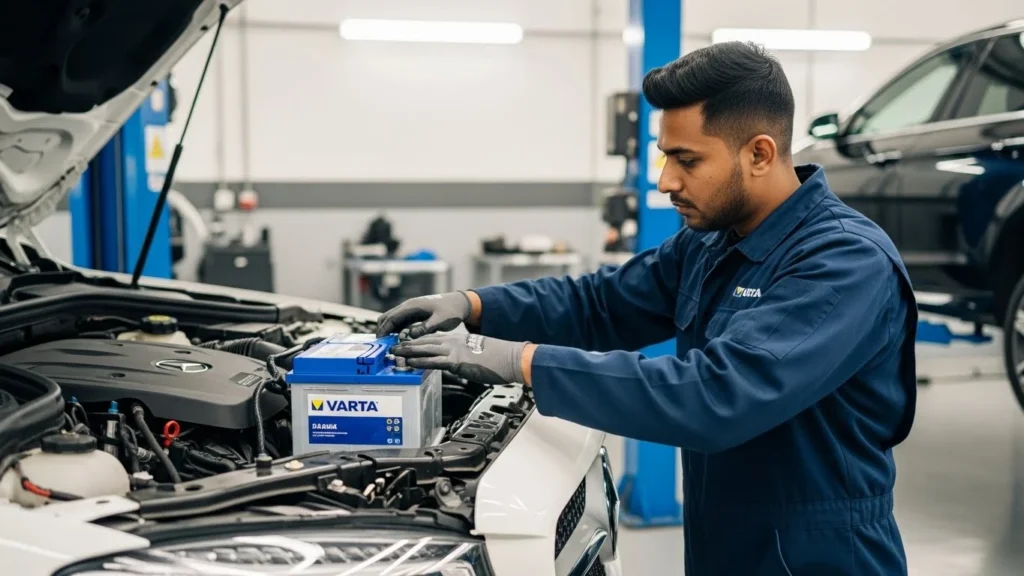
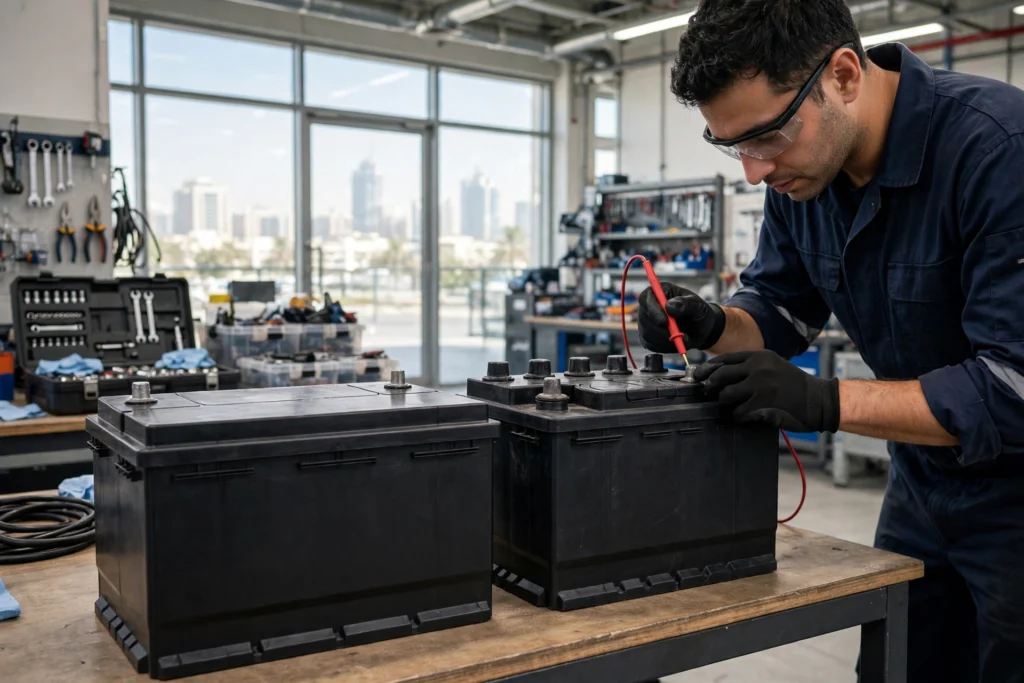
AGM battery vs normal battery is a question many Dubai drivers ask when a battery starts to weaken. The two types look alike from the outside, and both start the engine, but they work in different ways inside. Choosing the wrong type can shorten battery life or switch off a start-stop system. This guide explains both types in simple words, so you can tell which one your car was built for.
What Is a Normal Battery?
A normal battery, also called a flooded battery or a conventional battery, is the older and simpler design. Inside the case, lead plates sit in liquid electrolyte, which is a mix of water and acid. When you turn the key, the chemical reaction between the plates and the liquid gives the starter motor the power it needs. Once the engine is running, the alternator recharges the battery so it is ready for the next start.
This design has served cars well for many years. It gives a strong starting burst, it is simple to build, and it suits cars with modest electrical needs and no start-stop system.
There are limits to this design. The liquid inside can move, so the battery must stay upright. Over time, especially in heat, some of the water in the liquid can be lost. A flooded battery also copes less well with repeated deep discharge, which means it recovers less well after being run low again and again.
What Is an AGM Battery?
AGM stands for Absorbent Glass Mat. An AGM battery is a sealed, valve-regulated lead-acid battery. It uses the same basic chemistry as a normal battery, with lead plates and acid, but the acid is held inside fine fibreglass mats placed between the plates. There is no free liquid moving around inside the case.
Because the acid is held tightly against the plates, an AGM battery can deliver a strong current quickly and recharge faster than a flooded battery. The sealed design also makes it spill resistant, and it handles vibration better. These are the reasons car makers fit AGM batteries to many modern cars.
The main job of an AGM battery is to cope with hard work. In a start-stop car, the engine switches off at traffic lights and restarts many times on one journey, and the battery must recharge quickly in between. A normal battery is not built for that repeated cycle, while an AGM battery is made for it. You can read how car makers describe this job on the VARTA start-stop technology page.
AGM Battery vs Normal Battery: The Main Differences
How they are built
A normal battery holds liquid electrolyte around its plates. An AGM battery holds the electrolyte inside glass mats, so the case is sealed. This sealed build is also why an AGM battery is often heavier for the same size, because the plates and mats are packed tightly together.
Starting power
Both types can start an engine, but an AGM battery usually gives a stronger starting burst and keeps that strength over more starts. For a car that starts once and then runs for a long time, a normal battery is usually enough. For a car that restarts again and again in traffic, that extra strength matters.
Start-stop systems
This is the biggest difference. A start-stop system needs a battery that can handle many charge and discharge cycles in one day, and keep powering lights and screens while the engine is off. AGM batteries are built for that cycle. A normal battery fitted to a start-stop car will wear out early, and the system may stop working because the car protects a weak battery by keeping the engine running.
Charging and recovery
An AGM battery recharges faster, which helps on short trips and in traffic. It also copes better with running at a partly charged level, which happens when regenerative braking feeds energy back in small bursts. A normal battery prefers to stay fully charged, and repeated short trips can leave it slowly running low.
Heat in Dubai
Heat is hard on every car battery in Dubai. In a flooded battery, heat speeds up water loss and wear on the plates. In a sealed AGM battery, there is no free liquid to lose in the same way, so it copes better in that respect. Heat still shortens the life of an AGM battery, just as it does for every type. Parking in shade where possible helps both types last longer. Our guide to how long car batteries last in Dubai explains the signs that heat and age have started to wear a battery down.
Maintenance
A normal battery may need its terminals checked and cleaned, and on older serviceable types the liquid level may need attention. An AGM battery is sealed, so there is no liquid to top up. Both types still need clean, tight terminals and a working charging system.
Which One Does Your Car Need?
The short answer is simple: fit the type your car maker specified. Use these checks to find out what your car needs.
- Check the owner manual. It will say if the car needs an AGM battery. If it says AGM, fit AGM.
- Read the label on the old battery. Look for AGM, VRLA, or valve regulated. If the old battery is AGM, the replacement should be AGM too.
- Look for a start-stop system. If your car switches its engine off at traffic lights and restarts by itself, it almost always needs an AGM battery, or in some models an EFB battery.
- Think about electrical load. Cars with many driver aids, large screens, and advanced safety systems place a heavier load on the battery. AGM batteries are the usual fit for those cars.
- Check the size and terminal layout. Even the right type must match in size, terminal position, and starting strength for your model.
Never fit a normal battery to a car that came with AGM just because the two batteries look the same size. The car may need the new battery registered in its system after fitting, and skipping that step can shorten its life.
What About EFB Batteries?
You may also see the term EFB, which means Enhanced Flooded Battery. An EFB battery sits between the two types. It is still a flooded battery, but with stronger plates that help it cope with simple start-stop systems better than a normal battery. It does not match AGM for advanced start-stop cars with regenerative braking. If your car came with EFB, fit EFB, or AGM only if the car maker allows that step up for your model. If your car came with AGM, do not step down to EFB.
What You Can Check Yourself
You do not need tools for these checks. Do them in daylight, with the engine off.
Find the battery label
Open the bonnet and find the battery. Read the label for the type, size, and any start-stop marking, and take a photo of it before you shop for a replacement. If the battery is in the boot or under a seat, check the manual for its location first.
Look at the terminals
Check the two terminals for white, green, or crusty build up, and for any cable that feels loose. Corrosion on a terminal can stop a good battery from delivering power. Do not pour water on the terminals, and do not try to force a loose cable.
Watch how the car starts
Note slow cranking, dim lights when you start, or a start-stop system that has quietly stopped working. That system often stops switching the engine off when the car is protecting a weak battery. A dashboard battery warning light, or a car that needs a jump start after a short stop, also points to a problem that needs a test.
When a Workshop Test Comes First
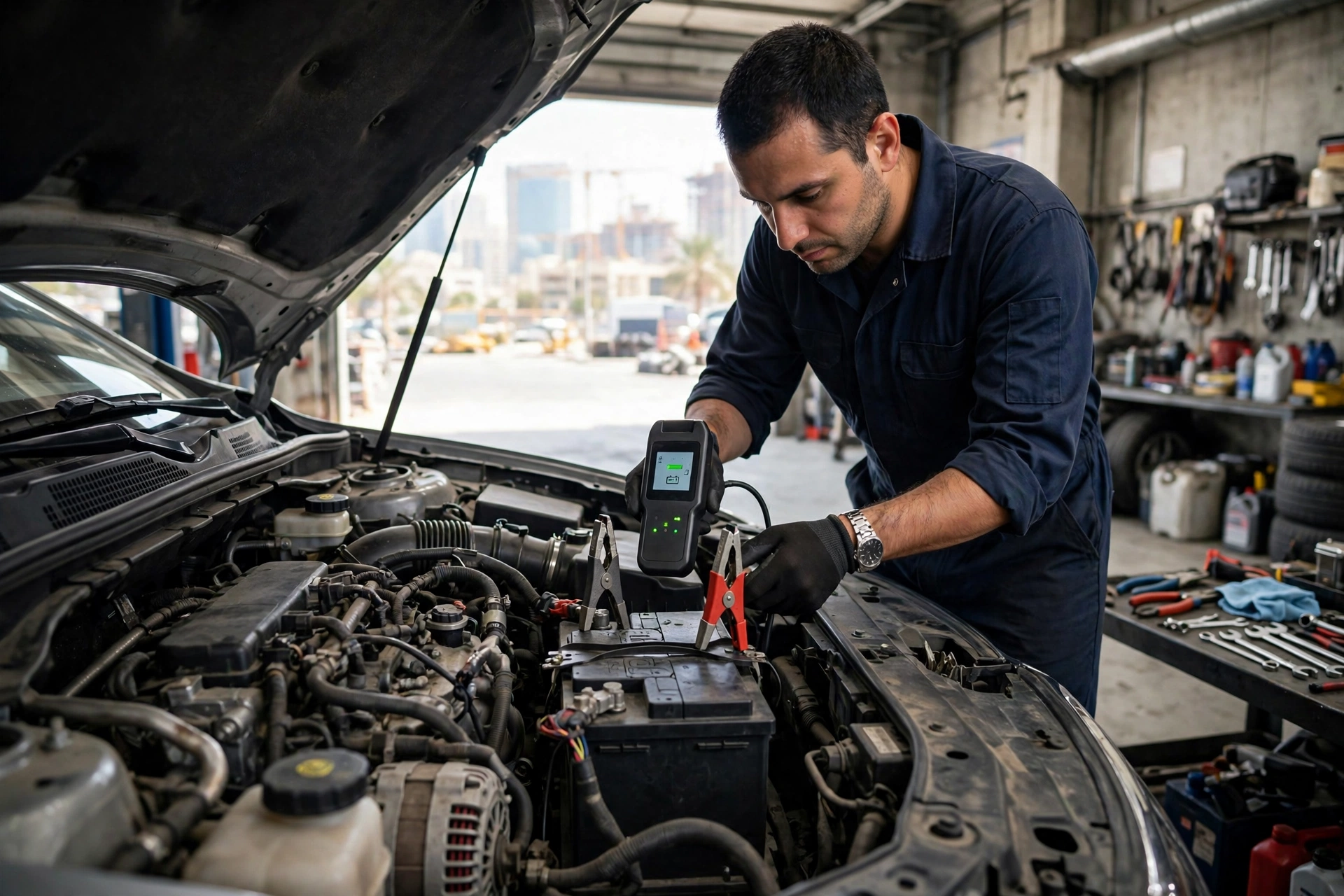
Before you buy a new battery, get the old one tested. Not every starting problem is the battery. The alternator, the starter motor, the terminals, and hidden electrical drains can copy the same symptoms. A proper test checks battery health, charging output, and starter draw together.
A workshop test also confirms the right replacement for your model, including the type, size, and starting strength, and whether the new battery needs to be registered in the car system after fitting. That step matters most on modern and start-stop cars, where the wrong type or a missed registration step can bring the problem back.
If your car needs a new battery, a car battery replacement check in Dubai covers the test, the correct type for your model, and the fitting. If the test shows a charging or starting fault instead, a car electrical repair check in Dubai can trace the fault before it leaves you stranded.
Frequently Asked Questions
Can I use a normal battery in a car that needs an AGM battery?
No, you should not. A car that needs AGM was set up for that type, including its charging profile and start-stop system. A normal battery in that car will wear out early, and the start-stop system may stop working. Always fit the type the car maker specified.
Can I upgrade a normal battery car to AGM?
In many cars, yes, if the size, terminal layout, and starting strength match and the charging system suits AGM. The upgrade can give stronger starting and better recovery after short trips. Check the manual or ask a workshop to confirm the fit for your model before you change type.
How do I know if my car has an AGM battery now?
Read the label on the battery for the words AGM, VRLA, or valve regulated, and check the owner manual for your model. If the car has a start-stop system, it very likely has an AGM or EFB battery. A workshop test can also confirm the type if the label is worn or hard to read.
Does an AGM battery last longer than a normal battery?
In a car that needs AGM, such as a start-stop car, an AGM battery usually lasts longer than a normal battery fitted to the same car, because it is built for repeated restarts. In a simple car with no start-stop system, a normal battery can serve well for its full life. Heat, short trips, and a faulty charging system shorten the life of both types.
Does an AGM battery need a special charger?
Yes, use a charger with an AGM setting when you charge an AGM battery at home. AGM batteries are sensitive to overcharging, and the wrong charger setting can damage them. If you are unsure about the charger, ask a workshop to charge or test the battery for you.
If your car is slow to start, or your start-stop system has stopped working, call or WhatsApp Expert Car Repair Dubai on +971 56 937 1471 or message us on WhatsApp. Our workshop is at the Binghatti Stars Building, Dubai Silicon Oasis, opposite Lulu Hypermarket, Dubai, UAE. We will test the battery, the charging system, and the starter, and tell you clearly whether your car needs an AGM battery or a normal battery.